
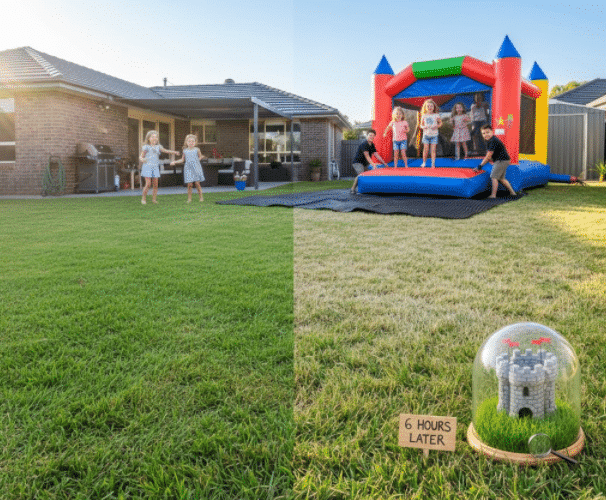
Planning a backyard “shindig” or a birthday party often involves the star of the show: the jumping castle. But if you’ve spent your weekends feeding, weeding, and mowing your lawn, you might be looking at that heavy PVC structure with a bit of trepidation.
Will six hours of party fun turn your lush green carpet into a yellow rectangle? Here is everything you need to know about grass health, recovery, and prevention.
The Short Answer: Yes and No
In the industry, we call the 6-hour mark the “Yellow Zone.” While your grass will definitely show signs of “stress,” it is very unlikely to die. Think of it as a temporary bruise rather than a permanent scar.
What Happens During Those 6 Hours?
- Blade Compression: Grass is surprisingly resilient, but 6 hours of heavy weight (plus kids jumping) forces the air out of the blades. They lose their “spring” and lay flat.
- The Sauna Effect: Especially in the Australian sun, the space between the castle’s base and the ground traps heat. If the ground is damp, you’re essentially creating a mini-sauna that can wilt the grass.
- Photosynthesis Pause: Without sunlight, the grass stops producing energy. Six hours isn’t enough to starve it, but it’s enough to make it look a bit “pale” and tired.
Survival by Grass Type
Not all turf is created equal. How your lawn handles a jumping castle depends largely on what you’ve planted:
- Sir Walter Buffalo / Buffalo Turf: Very hardy. It has a thick “thatch” layer that acts as a cushion. It will flatten but usually bounces back within 24 hours.
- Kikuyu: A fast grower. Even if it gets slightly yellow, Kikuyu’s aggressive growth habit means it will repair itself almost faster than you can notice the damage.
- Couch (Bermuda): Quite tough, but because it’s a finer leaf, it can be more sensitive to heat scalding under a plastic base.
- Cool Season Grasses (Fescue/Rye): These are the most sensitive. If it’s a hot day, keep a close eye on these as they don’t handle heat or weight as well as the “warm-season” varieties.
3 Pro-Tips to Prevent Permanent Damage
If you want to be the “Lawn Legend” of your street, follow these steps before the castle arrives:
- Don’t Water the Day Before: Wet soil compacts easily. Keep the ground dry and firm to prevent the castle from squashing the oxygen out of the root zone.
- Mow 2 Days Prior: Don’t mow right before the party. Longer grass provides a little extra “padding” for the soil.
- Choose the Right Spot: If possible, place the castle in a part of the yard that gets some afternoon shade. This reduces the “oven effect” under the PVC.
Post-Party Recovery: The “Lawn First Aid”
Once the hire company packs up, don’t just leave the grass as it is.
- Step 1: The Gentle Rake. Use a plastic leaf rake to gently “fluff” the flattened blades back up. This lets oxygen get to the soil immediately.
- Step 2: Deep Hydration. Give the area a good soak once the castle is gone. This cools the soil down and helps the grass cells re-inflate.
- Step 3: The No-Go Zone. Keep the dog and the kids off that specific patch for the rest of the evening.
Frequently Asked Questions (FAQ)
Q: Will the grass turn yellow? A: It might look a bit pale or “silvery” immediately after. True yellowing usually only happens after 12+ hours of coverage.
Q: Should I put a tarp under the castle? A: Generally, no. A tarp can actually trap more heat. Most hire companies provide their own professional-grade mats that are designed to be as breathable as possible.
Q: Is 6 hours too long? A: No. Most backyard hires are between 4 and 8 hours. Six hours is the “standard” and is considered safe for healthy, established lawns.
Bottom Line: Your lawn is tougher than you think! A 6-hour party might leave a temporary “shadow,” but with a quick rake and a drink of water, your grass will be back to its best in no time.