
If you run an event hire business or organize community festivals in Melbourne, you already know the golden rule: never trust the weather forecast.
Melbourne is famous for experiencing “four seasons in one day.” A bright, calm morning can rapidly transform into a gusty afternoon, driven by sudden cold fronts sweeping across Port Phillip Bay. While a rogue breeze might just mess up your hair, for a commercial jumping castle, it poses a severe, high-risk safety hazard.
Inadequately anchored inflatables can become airborne in strong wind gusts, leading to catastrophic accidents. To protect your young patrons, secure your business reputation, and stay fully compliant with Victorian laws, you must master the science of anchoring.
Here is your definitive guide to safely securing a commercial jumping castle in Melbourne’s unpredictable winds.
- Know the Legal Limit: The 40 km/h Rule
Under Australian Standard AS 3533.4.1 (Land-Borne Inflatable Devices) and WorkSafe Victoria guidelines, there is a hard legal limit for operating inflatables:
The Absolute Cutoff: All jumping castles must be evacuated and safely deflated before wind gusts reach the manufacturer’s specified limit, or a maximum of 40 km/h—whichever is lower.
In practice, experienced Melbourne operators don’t wait for 40 km/h. Because our wind gusts can spike instantly, it is industry best practice to begin a calm, controlled evacuation when sustained winds reach 25 to 30 km/h.
- Ground Stakes for Grass Surfaces: The 45-Degree Rule
Setting up on grass is the most common scenario for backyard parties, school ovals, and sports fields. However, simply pushing a few tent pegs into the dirt will not suffice for a heavy commercial-grade inflatable.
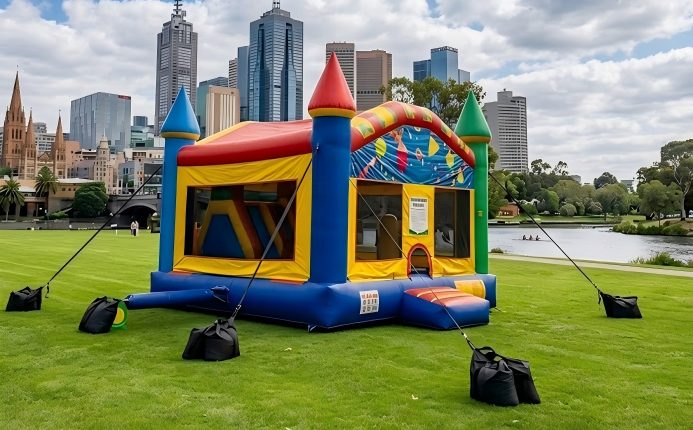
The Hardware: You must use heavy-duty steel stakes that are a minimum of 380mm long and at least 16mm in diameter. The Angle: Drive the stakes into the ground at a 45-degree angle, pointing away from the inflatable. This maximizes the ground’s resistance against the upward and lateral pull of the wind. Every Point Matters: You must utilize every single anchor point provided by the manufacturer. Never skip corners or skip an anchor tab just because the sun is shining.
Melbourne Soil Tip: Victoria’s soil varies wildly. If you are setting up in the sandy loam of the south-eastern suburbs (like Brighton or Frankston), stakes slip out much easier than they do in the heavy basalt clay of the western suburbs (like Werribee). Always test the firmness of the ground post-staking.
- Anchoring on Hard Surfaces: The Weight Calculations
When setting up on concrete, asphalt, or synthetic turf at school courtyards, festivals, or CBD laneways, stakes are not an option. You must rely on certified ballast (sandbags or concrete weights).
To safely secure a castle on hard stand surfaces, the weight required is massive. According to Australian Standards, each anchor point on a standard commercial jumping castle typically requires a minimum of 165 kg of weight.
Hard Surface Ballast Checklist:
- No “Lightweights”: Small 20kg gym weights or single sandbags are completely useless in a Melbourne gale.
- Securing the Ballast: Weights must be physically attached to the castle’s anchor points using high-tensile rated ropes or ratchet straps.
- Distribute Evenly: The weight must be spread evenly across all engineered points to prevent the structure from pivoting or tipping over.
- Watch Out for Micro-Climates and Wind Tunnels
Melbourne’s urban and suburban architecture can create unexpected wind hazards, even on days when the overall weather report seems calm.
- The Wind Tunnel Effect: Avoid setting up jumping castles in narrow outdoor spaces, such as between two large school halls, commercial buildings, or stadium structures. These narrow gaps accelerate wind speeds, turning a mild breeze into a dangerous gust localized entirely in that alleyway.
- Indoor Setups Are Not Risk-Free: If you are setting up inside an exhibition center, warehouse, or school gym, remember that large roller doors or open emergency exits can create massive indoor wind tunnels and sudden airflow changes. Ensure tall inflatables are appropriately weighted even indoors.
- Proactive Wind Management: Essential Tools
You cannot accurately measure wind speed by “feeling” it or checking a standard weather app on your phone. WorkSafe Victoria highly recommends having a handheld anemometer (wind speed meter) on-site.
The supervisor must take regular readings throughout the event and log them. If conditions become unpredictable, stop operation immediately, safely evacuate the users, open the deflation zippers, and turn off the blowers. A deflated castle cannot fly away.
Compliance and Peace of Mind
Operating a jumping castle hire business in Victoria comes with a strict duty of care. Before every setup, always conduct a thorough site risk assessment: check for underground utilities before driving stakes, ensure a 1.2-metre impact-absorbing soft-fall matting zone is placed around all open exits, and confirm your public liability insurance is up to date.
By adhering strictly to AS 3533.4.1, utilizing the correct anchoring hardware, and proactively monitoring the skies, you can deliver hours of safe, bouncy fun—no matter what moody weather Melbourne decides to throw your way.
Stay Safe, Stay Informed
At the end of the day, safety is a shared responsibility across the entire Melbourne event industry. Whether you are running a large-scale community festival in the North, hosting a school sports day in the East, or operating a family rental business in the West, keeping up with local regulations and weather conditions is the most effective way to ensure a successful and incident-free event.
Always keep a close eye on the Bureau of Meteorology (BOM) updates, trust your on-site anemometer, and never hesitate to deflate early if the wind starts to howl. A safe event is a successful event.